Cleaning the DPF on Volvo Trucks and Construction Equipment: Chemical vs. Ultrasonic — Which Is More Effective?
The Diesel Particulate Filter (DPF) is a key component of the emissions system—and at the same time, one of the most expensive and problematic parts found in modern Volvo trucks and construction equipment. When it becomes clogged, power drops, fuel consumption increases, turbo boost pressure faults appear, and the machine goes into derate mode.
For cleaning machine attachment filters, Volvo equipment owners usually use either and one of the following methods: ultrasonic cleaning and chemical cleaning. We will take an in-depth look at how each of the methods works, when each one works best, and which is the most suitable option for your circumstances.
How a Volvo DPF Gets Clogged
Volvo trucks and heavy equipment use wall-flow filters made of silicon carbide (SiC) or cordierite. Soot, ash from oil, and additive residue gradually clog the pores and channels.
Main causes of accelerated clogging:
frequent idling (construction sites, traffic);
poor-quality fuel or oil with high sulfur and ash content;
disabled or malfunctioning regeneration system (7th injector, pressure sensors);
short trips that prevent proper active regeneration.
Cleaning is required if you notice:
loss of power and slow acceleration;
frequent DPF regenerations;
differential pressure sensor faults;
increased fuel consumption;
derate mode or power limitation;
frequent interruptions of automatic regeneration.
If the filter isn’t physically damaged, it can be restored by 95–98% — the key is choosing the right cleaning method.
Chemical DPF Cleaning: Features and Effectiveness
How the method works
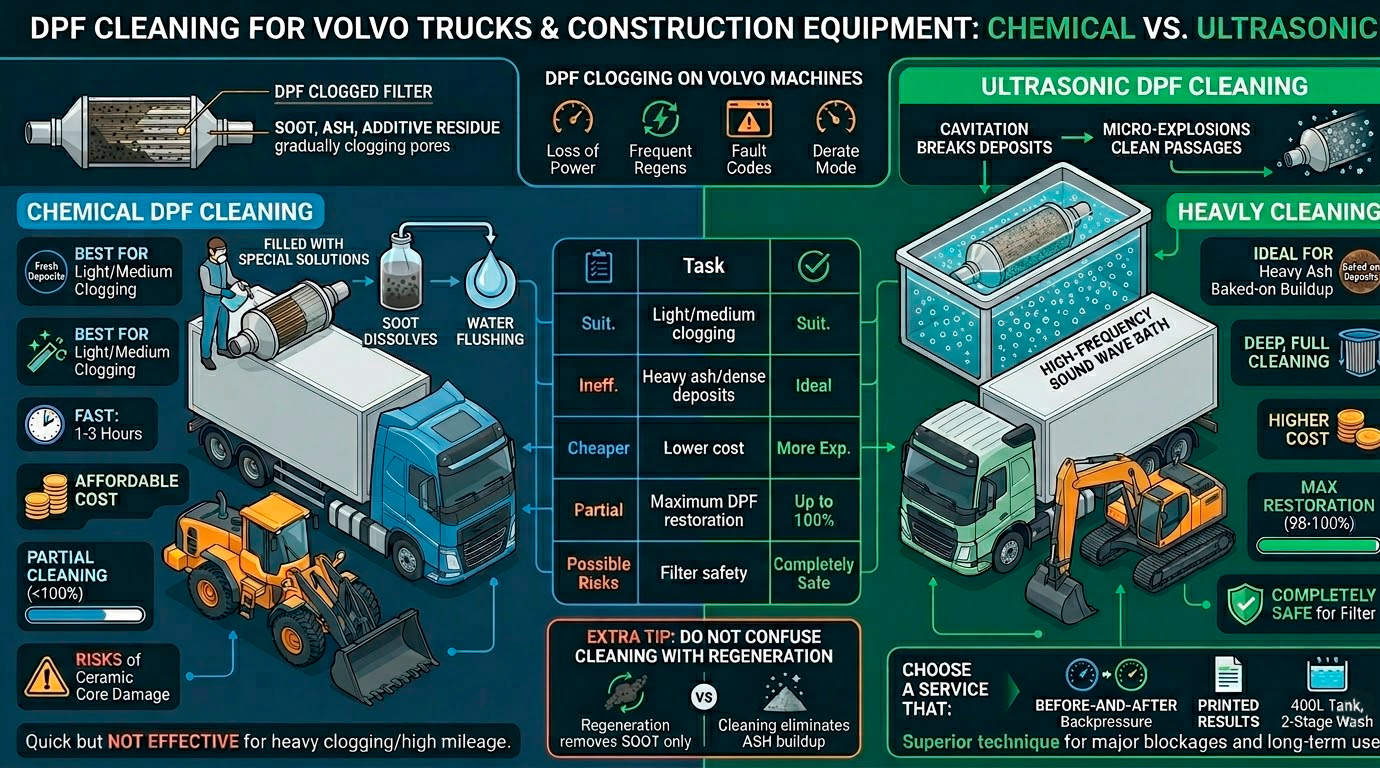
Chemical cleaning involves using special solutions that dissolve soot and ash deposits inside the filter channels. The filter is filled with a chemical agent and then flushed with water or rinsed under pressure.
Advantages
Suitable for moderate clogging.
Effective on soft or fresh deposits.
Fast procedure — 1 to 3 hours.
More affordable.
Disadvantages
May not remove dense ash or baked-on deposits.
Aggressive chemicals can potentially damage the ceramic core.
Often cleans only part of the channels — effectiveness is below 100%.
Bottom line: Although quick and effective, chemical cleaning is not effective for heavily clogged Volvo DFPs, especially for high mileage units or machines that are constantly under severe loads.
Ultrasonic DPF Cleaning: Maximum Restoration
How the technology works
Ultrasonic cleaning uses high-frequency sound waves in a water solution. These waves create microscopic cavitation bubbles—micro-explosions—that break loose deposits even in the narrowest passages of the DPF.
Advantages
Deep, full cleaning of the entire filter structure.
Removes dense ash that chemicals cannot dissolve.
Restores flow capacity to 98–100%.
Completely safe for the ceramic substrate.
Ideal for Volvo equipment after long-term use, dusty environments, hilly terrain, or low-temperature cycles.
Disadvantages
Higher cost compared to chemical cleaning.
Requires specialized equipment.
Bottom line: When it comes to cleaning issues such as big blockages or missing pressure faults, the best technique to use to clean Volvo FH, FM and FE FL trucks and Volvo CE construction equipment is ultrasonic cleaning.
Which Is Better for Your Volvo DPF: Chemical or Ultrasonic Cleaning?
Task | Chemical Cleaning | Ultrasonic Cleaning |
Light/medium clogging | Suitable | Suitable |
Heavy ash buildup, dense deposits | Ineffective | Ideal |
Lower cost | Cheaper | More expensive |
Maximum DPF restoration | Partial | Up to 100% |
Filter safety | Possible risks | Completely safe |
Extra Tip: Don’t Confuse Cleaning With Regeneration
Volvo vehicles with the DPF can use forced regeneration through the ECU. However, while regeneration removes soot, regeneration does nothing to eliminate the remaining ash. Even if diagnostics show a “successful regeneration,” the filter may still be 70–90% clogged with ash.
That’s why periodic cleaning (every 200,000–300,000 km) is recommended — ideally with ultrasonic technology, especially for equipment operating in severe conditions.
Personal Recommendation: Choose a Service That
Performs before-and-after backpressure measurements on a test bench;
Provides printed results “before” and “after”;
Uses a tank of at least 400 liters with a two-stage wash (alkali + neutralizer).
Conclusion
Chemical cleaning is a fast, budget-friendly way to remove some deposits. Ultrasonic cleaning is the best of all performing methods, and is also the most effective in restoring the DPF and extending its service life.
For Volvo trucks and construction equipment—especially high-mileage units or machines operating under heavy load—the optimal choice is ultrasonic cleaning. It ensures stable engine performance and minimizes risks to the filter.