

Volvo Construction Equipment Fault Codes Explained: Common Excavator, Wheel Loader and Dump Truck Diagnostic Codes

Understand Volvo Construction Equipment fault codes across excavators, wheel loaders, and articulated haulers. This guide covers engine, hydraulic, emissions, electrical, and communication faults, explains why complete codes and FMI suffixes matter, and outlines diagnostic checks to consider before replacing components or clearing codes.
What do Volvo Construction Equipment fault codes mean?
Volvo Construction Equipment fault codes describe messages that are displayed when a control system’s sensor, component, or subsystem recognizes an abnormal condition. Fault codes allow operators and technicians to understand the problem and fix it before the issue causes more damage and increases the machine’s downtime.
Volvo CE Fault Codes: What Every Equipment Owner Should Know
Volvo excavators, wheel loaders, articulated haulers, and other construction machines rely heavily on electronic control systems. These systems constantly monitor engine performance, hydraulics, emissions components, transmission operation, and dozens of sensors throughout the machine.
When something falls outside normal operating parameters, the machine records a fault code. Depending on the severity of the issue, operators may see a warning light, performance limitation, reduced hydraulic functionality, engine derate, or even a machine shutdown strategy designed to protect critical components.
We've put together this guide explaining common fault-code scenarios, how to interpret them, and what steps can be taken to resolve them.
Why Volvo CE Fault Codes Matter
Ignoring active fault codes can lead to:
Unexpected machine downtime
Reduced productivity
Increased fuel consumption
Hydraulic performance issues
Engine derates
DPF and SCR problems
More expensive repairs later
Modern Volvo construction equipment (CE) is designed to warn operators before a failure becomes catastrophic. Understanding those warnings can save time and money.
Most Common Volvo CE Diagnostic Categories
Although fault codes vary based on machine model and software versions, most fault codes for Volvo CE can be classified into several major categories.
System | Typical Issues |
Engine Management | Sensor failures, fuel system faults, turbocharger issues |
Hydraulic System | Pressure sensor faults, valve problems, hydraulic overheating |
Emissions System | DPF, SCR, DEF, NOx sensor faults |
Electrical System | Wiring issues, voltage problems, communication failures |
Transmission | Shift faults, speed sensor failures |
Cooling System | Temperature sensor, fan control, overheating issues |
Volvo Excavator Fault Codes

Excavators operate in some of the harshest environments possible. Dust, vibration, moisture, and continuous heavy loads place significant stress on electrical and hydraulic systems.
Common signs of excavator fault codes are:
Reduced hydraulic power
Slow boom or bucket operation
Engine warning lights
Excessive regeneration cycles
Reduced engine performance
Communication errors between modules
Frequent searches for “Volvo 210 excavator fault codes,” “Volvo 210 excavator error codes,” “Volvo 290 excavator error codes,” and “Volvo excavator diagnostic codes” suggest that operators come across diagnostic alerts very often and need to know the potential reasons in order to determine if they should call for service.
Volvo Excavator MA2301 Series: MA2301-03, MA2301-04 and MA2301-05
The MA2301 fault code series is associated with the cylinder 1 injector solenoid valve circuit on applicable Volvo CE excavators and equipment. The base code identifies the injector circuit, while the FMI number indicates the specific type of electrical fault detected by the machine's control system.
MA2301-03 — High Voltage
MA2301-03 indicates an FMI 3 high-voltage condition in the cylinder 1 injector solenoid valve circuit.
Possible causes include:
Short circuit to a higher voltage
Damaged injector wiring
Connector or terminal problems
Injector solenoid fault
ECU driver circuit problem
Not all the high-voltage faults are caused by a bad injector. Check the wiring and connectors and look for shorted circuits, frayed insulation, corrosion, and/or poor contact.
MA2301-04 — Low Voltage
MA2301-04 indicates an FMI 4 low-voltage condition in the cylinder 1 injector solenoid valve circuit.
Possible causes include:
Short circuit to ground
Low circuit voltage
Damaged or chafed wiring
Corroded connector terminals
Injector solenoid problem
Electrical supply or circuit fault
The diagnostic direction is different for MA2301-03 because the FMI will detect a low-voltage situation rather than a high-voltage one.
MA2301-05 — Current Below Normal or Open Circuit
MA2301-05 indicates an FMI 5. This is normally caused by current below normal or an open circuit in the cylinder 1 injector solenoid circuit.
Possible causes include:
Open injector circuit
Damaged wiring
Poor connector contact
Corroded terminals
Injector solenoid failure
Harness damage
Before changing the injector, technicians must check the complete electrical circuit harness, connectors, terminals, and injector solenoid.
IMPORTANT: The MA2301 series should not be diagnosed by the base code alone. The FMI number is critical because MA2301-03, MA2301-04, and MA2301-05 point toward different electrical conditions. Always verify the wiring and connector condition before condemning the injector or ECU.
In practical diagnostics, the best approach is to identify the FMI first, then check the corresponding electrical circuit. This can prevent costly injector replacement when issues are caused by damaged harnesses and poor wiring, loose connections, short circuits, or ECU driver issues.
Volvo Excavator P2002
P2002 is associated with diesel particulate filter efficiency below the expected threshold.
Possible causes include:
DPF restriction
Excessive soot or ash accumulation
Failed regeneration
Exhaust leakage
Differential pressure sensor problems
Temperature sensor faults
Other aftertreatment problems
A P2002 code does not automatically mean that the DPF needs to be replaced. The complete aftertreatment system should be checked first.
Volvo Excavator P0400
P0400 is associated with an exhaust gas recirculation (EGR) system or flow problem.
Possible causes include:
Restricted EGR passages
Carbon buildup
EGR valve problems
Sensor faults
Wiring problems
Intake or exhaust restrictions
If P0400 appears together with other engine or air-management codes, the related systems should be diagnosed together.
Volvo Excavator P24A400
P24A400 is associated with excessive diesel particulate filter soot accumulation.
Possible causes include:
Failed or incomplete regeneration
Excessive soot production
DPF restriction
EGR or air-intake problems
Exhaust temperature problems
Another fault preventing regeneration
Depending on the machine and severity, excessive soot loading can result in reduced engine performance or an engine derate.
Volvo Excavator ER44-03 and ER44-04
ER44-03 and ER44-04 are associated with the boost pressure sensor circuit.
ER44-03 — sensor voltage above the expected range
ER44-04 — sensor voltage below the expected range
Possible causes include:
Faulty boost pressure sensor
Damaged wiring
Corroded connector
Short circuit
Sensor power supply problems
Having a boost pressure sensor code does not always indicate that a turbocharger has failed.
MID 128 PID 411
MID 128 PID 411 is associated with EGR exhaust back pressure.
An abnormal reading can be related to:
Exhaust restriction
EGR system problems
Sensor faults
Wiring issues
Exhaust leakage
If this code appears together with EGR or DPF-related faults, the codes should be diagnosed as part of the same system.
MID 128 PPID 326
MID 128 PPID 326 is associated with soot level.
This code is particularly relevant when a Volvo excavator is experiencing frequent regeneration problems or DPF-related derates.
Possible causes include:
Excessive soot accumulation
DPF restriction
Failed regeneration
Regeneration being prevented by another fault
Aftertreatment problems
Volvo Excavator PSID200-09 and PSID200-12
PSID200-09 indicates a communication problem between the instrument control unit (I-ECU) and the engine control unit (E-ECU) over the CAN/J1939 network.
Possible causes include:
Open circuit in the communication harness
Short circuit to battery voltage
Short circuit to ground
CAN/J1939 wires shorted together
Electrical interference on the communication network
Connector or wiring problems
This fault can be particularly important when the machine also develops starting or engine-control problems because communication between the display and engine ECU may be interrupted. Volvo diagnostic information for PSID200 identifies loss of I-ECU-to-E-ECU J1939 communication as the fault condition.
PSID200-12 indicates a related communication fault involving the machine's control network. FMI 12 generally points toward a faulty component or communication-related condition rather than simply a low or high electrical signal.
When PSID200-09 and PSID200-12 appear together, technicians should investigate the communication network before replacing individual ECUs.
Volvo Excavator PSID202-09
PSID202-09 indicates missing communication between the V-ECU and I-ECU over CAN/J1939 on applicable Volvo CE systems.
Possible causes include:
Open CAN communication circuit
Damaged wiring
Short circuit to voltage
Short circuit to chassis ground
CAN wires shorted together
Connector problems
Electrical interference
Volvo Guided Diagnostics identifies PSID202 as the data link between the vehicle control unit and the information display/control system.
A PSID202 fault should therefore be investigated as a network communication problem rather than immediately assuming that one ECU has failed.
Volvo Excavator PSID203-09
PSID203-09 belongs to the same general family of Volvo proprietary communication/data-link faults.
When this type of code is active, check:
CAN/J1939 communication wiring
Connectors
ECU power supplies
Grounds
Communication termination
Related active communication codes
If several PSID communication codes appear at the same time, the common wiring or power supply should be investigated first.
Volvo Excavator PSID216-09 and PSID216-12
PSID216-09 indicates a communication failure involving the instrument control unit and another machine control unit over the CAN/J1939 network.
PSID216-12 indicates a corresponding communication problem involving the J1708/J1587 information link.
Volvo Guided Diagnostics documentation for PSID216 identifies loss of communication with the V-ECU over CAN/J1939 for FMI 9 and loss of communication over J1708/J1587 for FMI 12. Short circuits to voltage or ground, open circuits, or shorted communication lines can be possible causes.
What should you check for PSID216 faults?
CAN/J1939 wiring
J1708/J1587 wiring where applicable
ECU power and ground
Connector condition
Communication harness damage
Related PSID200/PSID202 faults
If several communication codes appear simultaneously, a common power, ground, or network problem is more likely than several ECUs failing at the same time.
Volvo Excavator SE2203
SE2203 is associated with the engine oil pressure sensor.
The code family can indicate different conditions depending on the FMI.
For example:
SE2203-01 — oil pressure below the expected operating range
SE2203-03 — sensor voltage too high
SE2203-04 — sensor voltage too low
Volvo CE diagnostic documentation identifies SE2203 as the engine oil pressure sensor associated with MID 128/PID 100.
Why is SE2203 important?
A genuine low oil-pressure condition can be serious and may activate engine protection.
Possible causes include:
Low engine oil level
Incorrect or degraded oil
Oil pump problems
Oil pressure regulation problems
Faulty pressure sensor
Wiring problems
If the fault indicates low oil pressure, actual oil pressure should be verified before continuing to operate the machine.
Volvo Excavator SE2203-05
SE2203-05 indicates an electrical fault in the engine oil pressure sensor circuit on applicable Volvo CE systems.
Possible causes include:
Open sensor circuit
Damaged signal wire
Poor connector contact
Sensor failure
Ground circuit problem
This type of code should be distinguished from an actual low oil-pressure condition. The engine oil pressure should still be verified if there is any doubt.
Volvo Excavator SE2301
SE2301 is associated with the fuel feed pressure sensor/fuel supply pressure system.
Different FMI conditions can indicate an electrical sensor problem or an actual fuel-pressure problem.
Possible causes include:
Faulty fuel pressure sensor
Open signal or supply circuit
Short circuit
Damaged connectors
Restricted fuel filter
Restricted fuel supply lines
Contaminated fuel
Air entering the fuel system
Fuel pump problems
Volvo Guided Diagnostics identifies SE2301 as MID 128 / PID 94 fuel feed pressure. On applicable machines, a mechanical low-pressure condition can affect fuel injection and engine power.
What should you check?
Start with the sensor circuit and then verify the actual fuel feed pressure.
Do not assume that replacing the pressure sensor will solve the problem if the measured fuel pressure is genuinely too low.
Volvo Excavator SE2603-03
SE2603-03 is associated with the engine coolant level sensor and an FMI 3 high-voltage condition.
Possible causes include:
Sensor circuit shorted to a higher voltage
Damaged wiring
Connector problems
Faulty coolant level sensor
Volvo CE diagnostic references identify SE2603 as the coolant level sensor, with FMI 3 corresponding to high voltage.
A coolant-level warning should never be ignored simply because the code appears to be electrical. The actual coolant level should also be checked.
Volvo Excavator SE2606
SE2606 is associated with the engine coolant temperature sensor.
The code can occur with different FMI conditions, including:
SE2606-00 — coolant temperature too high
SE2606-03 — sensor voltage too high
SE2606-04 — sensor voltage too low
Volvo CE references identify SE2606 as the engine coolant temperature sensor.
Possible causes include:
Actual engine overheating
Faulty temperature sensor
Wiring problems
Connector corrosion
Cooling-system problems
Incorrect sensor signal
When the temperature-related code indicates an actual overheating condition, the cooling system should be checked before focusing only on the electrical circuit.
Volvo Excavator SE2701-03
SE2701-03 is associated with the engine speed sensor at the flywheel and an FMI 3 high-voltage condition.
Possible causes include:
Engine speed sensor failure
Wiring shorted to a higher voltage
Connector problems
Sensor power-supply issue
ECU input circuit problem
Volvo CE references identify SE2701 as the engine speed sensor/flywheel sensor.
Because engine speed is essential for engine control and injection timing, this type of fault can have a more significant effect than a simple warning-light fault.
Volvo Excavator SE8701-11
SE8701 is associated with the air-conditioning refrigerant pressure monitor in the electronic climate-control system.
The -11 FMI indicates another or unspecified sensor fault condition on applicable systems.
Possible causes include:
Refrigerant pressure sensor problem
Sensor wiring fault
Connector problem
Incorrect refrigerant pressure
HVAC system fault
Volvo service information identifies SE8701 as the air-conditioner refrigerant pressure monitor.
This code belongs to the machine's climate-control system rather than the engine or hydraulic system.
Volvo Excavator SE8705-03
SE8705 is associated with the ambient air temperature sensor in the climate-control system.
FMI 3 indicates a high-voltage condition.
Possible causes include:
Open sensor circuit
Short circuit to higher voltage
Connector problem
Faulty ambient temperature sensor
Volvo Guided Diagnostics identifies SE8705 as the ambient air temperature sensor and documents FMI 3 as a voltage-above-normal condition.
An SE8705 fault can affect the accuracy of the machine's climate-control temperature information, but it is generally not an engine-performance fault.
Volvo Excavator SE9105-00 and SE9105-05
SE9105 is associated with the hydraulic oil temperature sensor on applicable Volvo CE systems.
The fault-code list includes SE9105-00 and SE9105-05.
SE9105-00 indicates that the hydraulic oil temperature is above the expected range.
Possible causes include:
Hydraulic oil overheating
Excessive machine load
Cooling-system problems
Hydraulic oil cooler problems
Incorrect temperature sensor reading
SE9105 is identified in Volvo CE diagnostic references as the hydraulic oil temperature sensor.
For a high-temperature code, the actual hydraulic oil temperature and cooling performance should be checked before replacing the sensor.
Volvo Excavator RE2501-05
RE2501-05 is associated with the intake-air preheating relay and an open-circuit/low-current condition.
Possible causes include:
Open relay circuit
Broken wiring
Faulty preheating relay
Connector problems
Fuse or power-supply issue
Volvo diagnostic references identify RE2501 as the intake preheating relay and FMI 5 as an open-circuit condition.
Symptoms
A problem with the preheating system can be especially noticeable during cold starts:
Difficult starting
Longer cranking
White smoke during cold start
Preheating system not activating
Volvo Excavator HE2501-05
HE2501-05 is associated with the intake-air preheating coil and an open-circuit condition.
Possible causes include:
Open heating element
Broken wiring
Damaged connector
Power-supply problem
Failed preheating component
Volvo CE fault-code references identify HE2501 as the induction-air preheating coil and FMI 5 as an open circuit.
This fault is particularly relevant when a machine becomes difficult to start in cold weather.
Volvo Excavator AL3201-12
AL3201-12 is associated with the alternator/charging system.
On applicable Volvo CE machines, the code is generated when the control system detects a low alternator signal for the specified operating conditions.
Possible causes include:
Alternator failure
Open or shorted wiring
Poor electrical connections
Charging-system problems
Battery or power-supply issues
Volvo Guided Diagnostics identifies AL3201 as Alternator 1 and describes the fault as a low signal condition. Possible symptoms include the battery charging indicator remaining illuminated and, in some cases, the engine stopping.
What should you check?
Check:
Alternator output
Battery voltage
Alternator wiring
Grounds
Connectors
Charging-system connections
Volvo Excavator PWM9109-05
PWM9109-05 indicates a current-below-normal or open-circuit condition in a PWM-controlled hydraulic output.
The exact controlled function depends on the machine configuration, but PWM outputs are used to control proportional hydraulic valves and other actuators.
Possible causes include:
Open circuit
Damaged wiring
Corroded connector
Failed solenoid coil
Poor ground
ECU output-driver problem
A PWM fault can result in reduced or lost proportional control of the affected hydraulic function. Volvo excavator service documentation lists PWM9109 among the hydraulic control components used on later excavator platforms.
What should you check?
Wiring from the controller to the valve
Connector condition
Solenoid resistance
Power and ground
Harness damage around moving hydraulic components
PWM output using appropriate diagnostic equipment
Volvo Wheel Loader Fault Codes

Wheel loaders experience some of the same challenges but also have specific challenges like:
Transmission operation
Drivetrain components
Differential locks
Hydraulic lift systems
Load-sensing functions
Engine aftertreatment systems
When active fault codes appear, the machine may continue operating normally, enter a limited-performance mode, or restrict certain functions to protect critical systems.
Volvo Loader P20EE00
P20EE00 is associated with SCR NOx catalyst efficiency below the expected threshold.
Possible causes include:
Poor or contaminated DEF
DEF dosing problems
NOx sensor faults
Exhaust leakage
SCR catalyst problems
Incorrect exhaust temperatures
The NOx sensor should not automatically be replaced simply because P20EE00 is present. The complete SCR system should be checked.
Volvo Loader P2202
P2202 is associated with a low-input condition in the NOx sensor circuit.
Possible causes include:
NOx sensor problems
Wiring damage
Connector corrosion
Power supply problems
Electrical circuit faults
Volvo Loader P208A00
P208A00 is associated with the reductant/DEF pump control circuit.
Possible causes include:
DEF pump electrical failure
Damaged wiring
Connector problems
Low system voltage
Pump failure
DEF system problems
A DEF pump fault can eventually result in additional SCR and NOx-related fault codes.
Volvo Loader P229F
P229F is associated with a NOx sensor performance problem on applicable systems.
Possible causes include:
NOx sensor failure
Wiring problems
Connector damage
Exhaust leakage
Incorrect sensor readings
Related SCR problems
Other emissions codes should be checked at the same time.
MID 128 PPID 279
MID 128 PPID 279 is a Volvo-specific engine diagnostic parameter. Its exact interpretation should be checked together with the FMI and machine configuration.
When diagnosing this type of code, record the complete diagnostic message rather than relying on the PPID number alone.
Volvo Dump Truck Fault Codes

Volvo articulated dump trucks use many of the same engine and emissions technologies found on modern excavators and wheel loaders.
Commonly searched codes include:
P2048
P042000
P2047
P008A00
MID 128 PPID 273
Volvo Dump Truck P2047
P2047 is associated with an open circuit condition for the reductant injection valve.
Possible causes include:
Broken wiring
Disconnected dosing valve
Damaged connector
Failed dosing valve
Control circuit problems
Volvo Dump Truck P2048
P2048 is associated with a low circuit condition for the reductant injection valve.
Possible causes include:
DEF dosing valve problems
Damaged wiring
Corroded connectors
Electrical circuit faults
Control circuit problems
Volvo Dump Truck P008A00
P008A00 indicates that low-pressure fuel system pressure is below the expected level.
Possible causes include:
Restricted fuel filter
Low fuel level
Fuel-line restriction
Air entering the fuel system
Fuel tank ventilation problems
Fuel pressure sensor problems
Fuel pressure should be checked before replacing the fuel pump.
Volvo Dump Truck P042000
P042000 relates to catalyst system efficiency being below expected level.
Possible causes can include:
Catalyst performance problems
Exhaust leakage
Temperature sensor problems
Aftertreatment dosing problems
Regeneration issues
The diagnostic process depends on both a machine's configuration and the aftertreatment configuration.
MID 128 PPID 273
MID 128 PPID 273 is a Volvo-specific engine parameter code. Its exact meaning depends on the FMI and the particular machine configuration.
Complete the MID/PPID/FMI combination when recording to ensure an accurate diagnosis, then check for any active related codes.
Understanding Volvo CE Diagnostic Codes
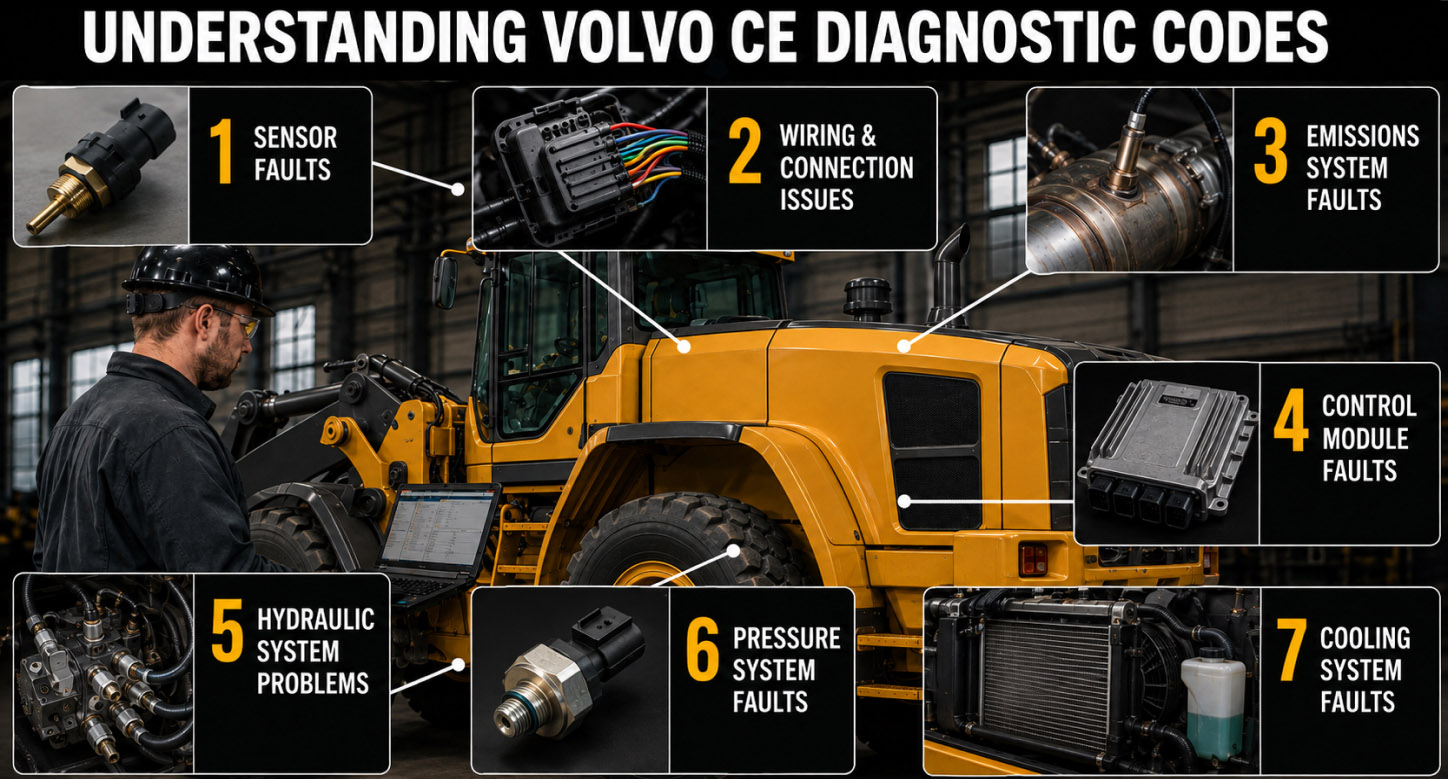
Most Volvo Construction Equipment fault codes are generated when the machine detects:
Sensor Problems
Sensors constantly provide information about:
Temperature
Pressure
Fuel delivery
Engine speed
Hydraulic operation
Exhaust conditions
A failed sensor may trigger a fault code even when the component it monitors is functioning correctly.
Wiring and Communication Issues
Construction environments are extremely demanding on electrical systems.
Common causes include:
Damaged harnesses
Corroded connectors
Water intrusion
CAN communication failures
Low system voltage
These problems usually create fault codes that can randomly go away and return at any time.
Emissions System Faults
Modern Volvo CE machines use advanced emissions systems including:
DPF
SCR/DEF/AdBlue
EGR
NOx sensors
As machines accumulate hours, emissions-related fault codes can become increasingly common and may eventually trigger engine derates.
Important Note About Volvo CE Proprietary Codes
Volvo Construction Equipment implements many of its own code formats, like MA, SE, FX, FU, PSID, PWM, SW, and AL codes in certain machinery.
These codes are not always interchangeable between machine generations.
For accurate diagnosis, record the complete code exactly as displayed, including the FMI suffix when present.
For example:
MA2301-03
MA2301-05
SE2603-03
PSID216-09
PSID216-12
AL3201-12
The difference between two FMI values can completely change the diagnostic direction.
A code indicating high voltage, low voltage, open circuit, abnormal data, or a mechanical condition may require completely different troubleshooting procedures.
Important: Always verify proprietary Volvo CE codes against the machine's exact model, serial number, ECU configuration, and applicable service information before replacing components.
How to Clear Volvo Excavator Fault Codes
One of the first questions operators have is:
"How do I clear codes on a Volvo excavator?"
The answer depends on the cause of the fault.
In many cases:
The underlying problem must be repaired first.
Active codes will remain until the fault is resolved.
Some inactive codes clear automatically after successful operating cycles.
Others require diagnostic software to clear manually.
Simply clearing a fault code without correcting the root cause usually results in the code returning.
What Should You Check When a Volvo CE Fault Code Appears?
A useful diagnostic process is:
Record the complete fault code.
Check whether the code is active or inactive.
Review the similar codes.
Check wiring and connectors.
Check sensor or component that fails.
Review live data where available.
Check recent repairs or maintenance.
Don’t clear the code until you’ve fixed the problem.
Test the machine and scan it again.
For Volvo-specific codes, the complete code combination is important. For example, MID 128 together with a PID, PPID, SID, and FMI provides considerably more information than MID 128 alone.
Best Practices for Preventing Fault Codes
To reduce unexpected downtime:
Perform regular preventive maintenance
Inspect wiring harnesses routinely
Keep electrical connectors clean
Address warning lights immediately
Use high-quality fluids and filters
Monitor regeneration performance
Check DEF quality and storage conditions
Inspect exhaust and intake connections
Perform periodic diagnostic scans
Proactive maintenance remains far less expensive than emergency repairs.
How DrunkLab Can Help
DrunkLab provides remote ECU programming, stock programming, software recovery, and Volvo Construction Equipment tuning solutions for supported Volvo CE platforms.
Many fault codes are symptoms of software issues, communication failures, emissions-system problems, or mismatched programs. Our engineers can assist with troubleshooting, analysis of the ECU, programming support, and tuning solutions to get your gear moving again with minimal waiting time.
Our team knows how to deal with Volvo excavators, loaders, haulers, equipment, and other construction vehicles. We can diagnose the reason behind persistent fault codes and pinpoint the most cost-effective way to get your equipment back dug or wheeled out of the way, minimizing machine downtime.
FAQ
What does each Volvo excavator fault code indicate?
Each Volvo excavator fault code is a definition for each symptom of the problem in the engine, hydraulic, electrical, emission control, or controller part of the machine.
What are Volvo 290 excavator error codes?
The Volvo 290 excavator has a range of error codes based on the machine generation and engine configuration. Categories for such codes may include engine, hydraulic, electric and emissions fault codes.
What does MA2301-5 mean on a Volvo excavator?
MA2301-5 is associated with a cylinder 1 injector circuit condition on applicable Volvo CE systems, with FMI 5 indicating current below normal or an open circuit.
What does P20EE00 mean on a Volvo loader?
P20EE00 indicates that SCR catalyst efficiency has dropped below the expected level. Check DEF quality and dosing, exhaust leaks, NOx sensors, and overall SCR system performance.
What does P008A00 mean on a Volvo dump truck?
P008A00 points to low pressure in the low-pressure fuel system. This can be attributed to several things like a weak fuel filter or weak fuel lines, fuel pump, or even a failing pressure sensor.
Can Volvo CE fault codes cause an engine derate?
Yes. Some DPF, SCR, DEF, fuel-system, turbocharger, and other engine-related faults can trigger a derate or other protection strategy depending on the machine and engine configuration.
Can I clear Volvo excavator fault codes myself?
Some inactive codes may clear automatically, but active faults normally require the underlying problem to be repaired first. Some codes require diagnostic software to clear.
Why does my Volvo wheel loader keep showing warning lights?
Repeated warning lights usually indicate an unresolved sensor, wiring, hydraulic, engine, or emissions-system problem.
What causes communication fault codes on Volvo CE equipment?
Communication faults are commonly caused by damaged wiring, loose connectors, CAN network problems, low voltage, or controller failures.
Are Volvo CE fault codes the same across all machine models?
No, not in one word. Definitions of fault codes vary across lots of things, like different models of machines, model years, different engine types, and the types (and perhaps even variations in) of software and control systems.
Can DrunkLab help diagnose Volvo CE fault codes remotely?
Yes. Through the M4 App, DrunkLab provides Volvo CE customers remote services for fault code reading, ECU analysis, programming support and troubleshooting for supported Volvo CE platforms.
сдобрить картинками, вот из видео например https://www.youtube.com/shorts/fUsZb7qaYVw
Review
You can leave a review on the contact page.
Related Articles
Mochester App (M4 App) for Volvo Construction Equipment: Smart Diagnostics and Tuning Made Easy
Remote tuning solutions for Volvo construction machines are available through the Mochester App (M4 App). This guide outlines the App's primary functions and how to use it to enhance the performance of your machines, minimize their downtime, and better their fuel efficiency.

Volvo Construction Equipment Software: Solutions for Diagnostics and Tuning
Modern Volvo Construction Equipment depends on sophisticated electronic systems that use software for diagnostics and optimization. This article analyzes the most common tools such as Volvo Tech Tool, VCADS Pro, Jaltest, and Mochester App, and their functions regarding fault identification, ECU programming, and system calibration. Other tuning options including performance optimization as well as DPF, EGR, and SCR deletes are discussed. Overall, correct application of these tools and techniques can help minimize production downtime, enhance operational efficiency, and prolong the natural working life of Volvo CE equipment.

Volvo Construction Equipment Fault Codes List: Overview of Common Errors and Their Meanings
A practical overview of common Volvo CE fault codes, how to read them, and what they mean for diagnostics and repair.